Fenestration Knowledge Series · Article 04
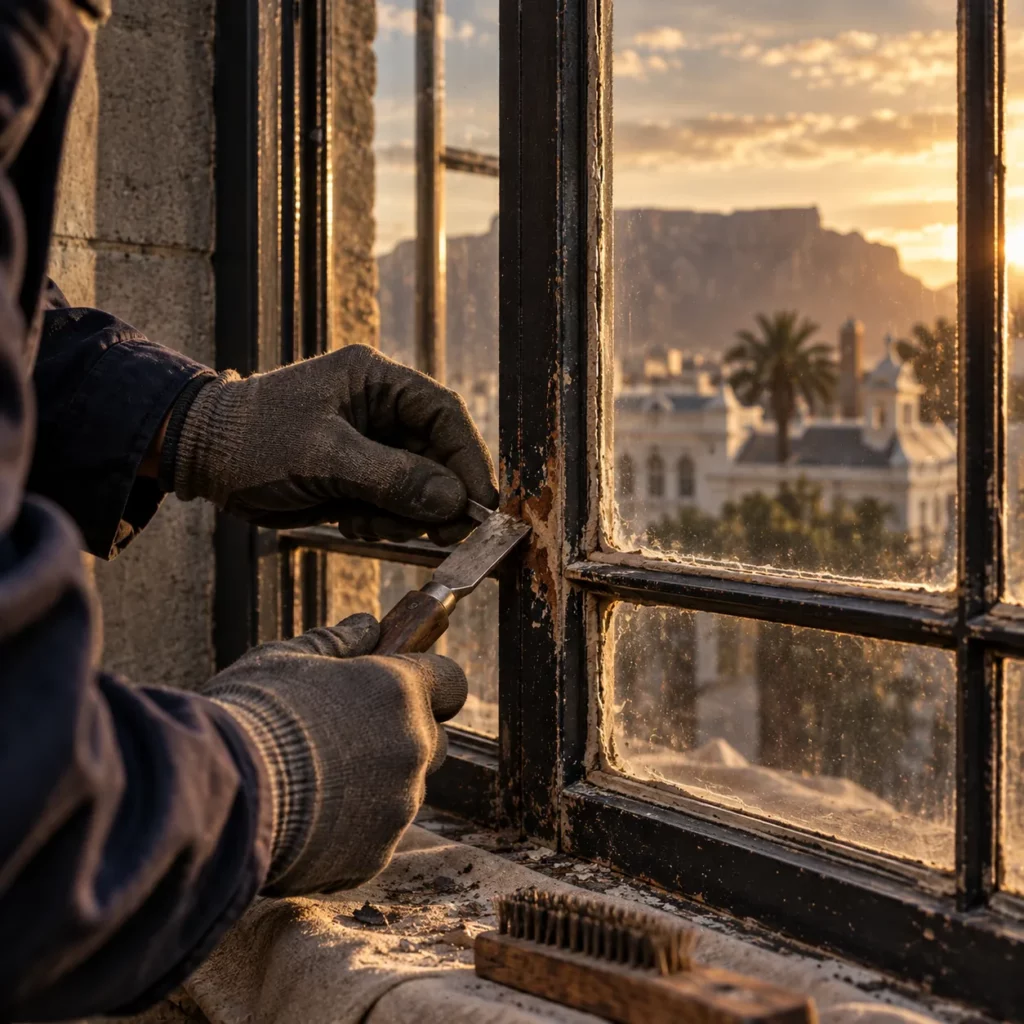
Rust does not automatically mean replacement.
That is one of the most important facts to understand when assessing an old steel window.
Flaking paint, failed putty, stiff hinges and local corrosion can make a frame look terminal. Yet those symptoms often sit at the surface of a fundamentally strong assembly. Steel is repairable. Individual sections can be cleaned, straightened, welded, protected and reglazed. Hardware can be serviced. Weather sealing can be improved. Significant old glass can often be retained.
The right starting point is therefore not a replacement catalogue.
It is a careful assessment of what survives, what has failed and what can be repaired.
This is Article 04 in the D&G Window Solutions Fenestration Knowledge Series. In Article 03, we followed the history of steel windows from industrial production to Modernist architecture. Here we look at the practical decision that follows: repair or replace?
Repair first does not mean repair at any cost
A repair-first approach is not sentimental, and it does not mean every old frame must remain regardless of condition.
It means replacement should be the conclusion of an informed assessment—not the assumption made before inspection begins.
Some windows have lost too much material. Some have been badly altered. Some cannot meet an essential safety or performance requirement without disproportionate intervention. In those cases, selective or complete replacement may be justified.
But many heritage steel windows are removed because corrosion looks worse than it is, because operation has been neglected, or because a standard replacement product is easier to price than a skilled repair scope.
Historic England notes that rust can occupy many times the volume of the sound metal from which it formed. A swollen, flaky corner may therefore look dramatic while substantial steel remains beneath it. Only cleaning and close inspection reveal the real condition.
The window is part of the architecture
A heritage steel window is more than a frame holding glass.
Its dimensions establish the rhythm of the façade. The depth of the reveal, the width of the outer frame, the thin glazing bars, the pane proportions and the position of opening lights all affect how the building reads.
Original windows may also retain:
- rolled-steel profiles that are no longer standard;
- early hinges, handles, stays and catches;
- hand-fitted junctions and fixings;
- historic paint evidence;
- old glass with subtle waves, seeds and reflections;
- a relationship to the surrounding masonry that a modern unit cannot reproduce automatically.
When these details are lost, copying the broad grid is not enough. A thicker replacement frame can reduce the glazed area, flatten the shadow lines and make a previously delicate elevation appear heavy.
The US National Park Service describes historic steel windows as character-defining features in many late-nineteenth- and twentieth-century buildings. It recommends that their significance and condition be assessed before a replacement decision is made.
Why apparently poor windows may still be repairable
Most failures begin with water and neglected protective coatings.
Traditional mild-steel windows rely on paint—or, in later examples, galvanising and paint—to isolate the metal from moisture and oxygen. When paint cracks, glazing putty fails or water becomes trapped at bottom rails and glazing bars, corrosion begins.
Common symptoms include:
- surface rust beneath loose paint;
- failed or missing glazing putty;
- cracked panes caused by corrosion pressure or movement;
- paint build-up that prevents casements closing;
- seized hinges, handles or stays;
- distorted opening lights;
- failed perimeter seals;
- local section loss at corners, bottom rails or frame-to-wall junctions;
- rust staining on adjacent masonry.
These symptoms do not all have the same significance. Paint build-up and seized hardware are maintenance problems. Surface corrosion may require cleaning and protection. Local section loss may require a welded-in repair. Widespread perforation or failure at multiple structural points is more serious.
The value of a specialist survey is that it separates these conditions instead of treating every rusty window as one problem.
What a proper assessment should examine
An assessment should record the window as a complete system: frame, opening sash, glazing, hardware, fixings, perimeter and surrounding wall.
- Significance. Is the window original? Does it define the façade or form part of a repeated group?
- Steel condition. Is corrosion superficial, localised or extensive? How much sound section remains?
- Geometry. Are the frame and casements square, straight and capable of operating?
- Joints and fixings. Are welds, rivets, tenons, lugs and anchors sound?
- Hardware. Can hinges, handles, stays and catches be serviced or replicated?
- Glazing. Is the glass sound, historically significant, safely retained and suitable for the building’s use?
- Water management. Have putty, sealants, drainage paths or masonry defects allowed moisture to remain against the steel?
- Coatings. Is the existing paint system compatible, and has corrosion developed beneath it?
- Performance needs. What weather, acoustic, thermal, security and safety requirements must the repaired opening meet?
- Access and sequence. Can work be completed in situ, or should opening lights or complete frames be removed to a workshop?
A representative trial repair can be valuable on a larger project. It exposes the true condition, tests the proposed method and gives the project team a reliable basis for scope and cost.
What steel-window restoration actually involves
Good restoration is a sequence, not a cosmetic coat of paint.
The exact method depends on the window and the building, but a professional repair programme may include the following stages.
1. Record and protect
Frames, opening lights, glass and hardware are photographed, labelled and measured. Significant glass is identified before dismantling. Adjacent masonry, finishes and occupied interiors are protected.
2. Release and dismantle carefully
Painted-shut casements are freed without forcing the frame. Opening lights may be removed while the built-in outer frame remains in place. Complete removal is used where workshop access is necessary and surrounding fabric can be protected.
3. Remove failed coatings and corrosion
Loose paint, rust scale and failed putty are removed by methods suited to the frame and the site. Workshop blasting can be effective for dismantled mild-steel units; careful hand or mechanical preparation may be more appropriate in situ.
The objective is to expose sound metal without damaging thin profiles, historic glass or surrounding finishes.
4. Repair the steel
Distorted sections are realigned. Localised perforation can be cut back to sound metal and repaired with matching steel. Failed joints, hinges and fixing points can be rebuilt or welded by a metalworker with the required fabrication and welding capability.
This is where repair differs fundamentally from patching. Filler may hide a hole; it does not restore the strength or shape of the steel.
5. Service the operating system
Hinges, pivots, handles, stays and catches are cleaned, adjusted and repaired. Missing pieces can sometimes be replicated. The goal is not merely that the sash moves, but that it closes squarely and engages its hardware without strain.
6. Protect the metal
Prepared steel needs a compatible protective system. Depending on the project, that may include zinc-rich treatment, suitable primers and durable finish coats. Coating edges, recesses and repaired junctions properly is as important as the visible face.
7. Reglaze and weather-seal
Sound original glass can often be reset. Where panes must be replaced, glass is selected for safety, appearance and compatibility with the available rebate. Glazing clips, putty or appropriate modern compounds are installed to suit the frame. Perimeters are sealed while allowing the building assembly to manage water correctly.
8. Reinstall, adjust and test
The window is refitted, aligned and operated. Hardware engagement, water paths, coatings, glass support and final seals are checked as one system.
This integrated approach is central to D&G Window Solutions’ steel-window refurbishment and mechanical servicing and heritage steel-window restoration work.
Can repaired steel windows perform better?
Yes—but the upgrade must respect the frame.
Air leakage frequently comes from failed perimeter seals, loose opening lights, worn hardware and gaps created by distortion or paint build-up. Correcting those faults can improve comfort before the glass specification is changed.
Possible performance measures include:
- servicing and realigning opening casements;
- renewing appropriate weather seals;
- repairing putty and perimeter joints;
- retaining historic glass and adding discreet secondary glazing where appropriate;
- installing safety glass in risk locations when the rebate and design permit;
- using carefully selected replacement glazing where original panes are already lost or unsuitable.
The National Park Service documents repair, weatherisation, storm-panel and thermal-glazing options for existing steel windows. Not every method suits every frame. Glass thickness, rebate depth, glazing method, condensation risk, added weight and the visual effect must all be checked.
Performance should be specified around the building’s real needs—not around a generic claim that every old window must become a new insulated unit.
The hidden cost of unnecessary replacement
Replacement has consequences beyond the purchase price.
Removing a built-in steel frame can damage plaster, brickwork, stone or concrete reveals. New profiles may require packers, cover trims and sealant joints that alter the original depth and sightlines. Adjacent finishes must then be repaired. If the replacement grid does not align precisely with the original, the effect repeats across the entire façade.
There is also the loss of serviceable material and workmanship. A frame that has already lasted many decades may have a long future once corrosion paths are corrected and protection is restored.
Repair can therefore retain architectural character while concentrating new material where it is genuinely needed.
When replacement is the right decision
Replacement can be appropriate when evidence shows that repair cannot deliver a sound, safe and durable result.
- extensive section loss across primary frame members;
- repeated failure at joints and fixings;
- severe distortion that cannot be corrected reliably;
- an existing window that is itself an inappropriate later alteration;
- essential safety or performance requirements that the original system cannot reasonably meet;
- a carefully considered and approved change to the building.
Even then, the assessment should guide the new work. The replacement should respond to the original frame depth, sightlines, pane pattern, opening method, hardware, glass position and relationship to the wall—not simply its overall width and height.
Where complete replacement is justified, purpose-made steel windows and doors can preserve slender proportions more faithfully than a generic substitute. Custom aluminium systems may be appropriate in other contexts, but the material and profile should be selected deliberately rather than treated as visually interchangeable with historic steel.
Cape Town heritage approvals matter
In Cape Town and the Western Cape, a technical decision may also be a heritage-approval decision.
The City of Cape Town advises that alterations to structures older than 60 years generally require heritage approval, with the applicable route depending on the property’s location, status and any exemption area or Heritage Protection Overlay Zoning. Owners should confirm requirements with the relevant authority before work begins.
Repair-first planning helps here too. A measured survey, clear photographs, a statement of significance and a defined repair methodology give the owner and project team better information for an application than a broad proposal to remove all windows.
A better sequence for the decision
- document the existing windows;
- establish heritage significance and approval requirements;
- clean and inspect representative areas;
- separate maintenance, local repair and genuine failure;
- test a repair method where uncertainty remains;
- define performance and safety requirements;
- compare repair, selective replacement and complete replacement on the same evidence;
- proceed with the least destructive solution that will perform properly.
That sequence protects both the building and the client’s budget from a premature all-or-nothing decision.
Repair before replacement
Heritage steel windows were made to be assembled, serviced and worked by skilled hands. That does not make them indestructible, but it does make many of them far more repairable than their appearance suggests.
Rust is a condition to diagnose—not a verdict.
Before an original steel window is removed, understand what it contributes, expose the true condition and ask what targeted repair can achieve.
The right answer may be maintenance. It may be workshop restoration. It may be selective new steel. Occasionally, it will be complete replacement.
But the decision should start with the window that is already there.
The D&G Fenestration Knowledge Series
- Article 01: The History of Glass—How One Material Changed the Way We Build
- Article 02: Why Old Glass Looks Wavy—and Why It Matters
- Article 03: The History of Steel Windows
- Article 04: Why Heritage Steel Windows Should Be Repaired Before They Are Replaced
- Coming next: How Modern Safety Glass Actually Works
Do you have original steel windows that are rusted, difficult to operate or being considered for replacement?
Request a heritage steel-window assessment or quotation from D&G Window Solutions.
Further reading and sources
- US National Park Service: The Repair and Thermal Upgrading of Historic Steel Windows
- US National Park Service: Repairing Steel Casement Windows
- Historic England: Repair or Change Windows in an Older Home
- Historic England: Traditional Windows—Their Care, Repair and Upgrading
- City of Cape Town: Your Heritage Site or Building