
Fenestration Knowledge Series · Article 03
Steel windows have moved through an unusual architectural life. They began as practical products of industrial manufacturing, became symbols of factories and modern buildings, entered houses, schools, hospitals and shopfronts, and then faced strong competition from aluminium and other systems.
Yet steel never disappeared. Its narrow profiles, precise grids and structural character remained difficult to imitate. Today, architects and owners again choose steel not simply for nostalgia, but because it can create windows and doors that feel both disciplined and remarkably light.
The history of steel windows is the story of how strength was used to admit more light.
This is Article 03 in the D&G Window Solutions Fenestration Knowledge Series. In Article 01, we followed glass from ancient making to modern high-performance glazing. In Article 02, we examined what the waves and bubbles in historic panes reveal. Now we turn to the frame that helped larger areas of glass become part of everyday architecture.
Before steel: iron casements and small panes
Metal windows existed long before the familiar rolled-steel casement. Earlier openings could use wrought-iron glazing bars, cast-iron elements, leaded lights or timber frames. The material, glassmaking process and available manufacturing methods all limited what was practical.
Small panes were not merely a decorative preference. Glass was expensive and difficult to produce in large, consistent sheets. The frame therefore had to hold many individual pieces. As glassmaking improved during the nineteenth century, larger panes became possible—but the supporting frame still needed to be strong, repeatable and economical.
Industrialisation changed both sides of that equation. Factories could make increasingly uniform glass, and new processes made steel available in greater quantities. The Science Museum records Henry Bessemer’s 1856 process as a major step towards the bulk production of steel. That development transformed railways, construction and manufacturing. It also helped create the conditions in which a window frame could be rolled into slim, standard sections rather than formed as a one-off piece of ironwork.
Industrial production changes the window
Mild-steel window frames began to develop during the second half of the nineteenth century. Steel combined useful strength with the ability to be rolled, cut and assembled into consistent profiles. A slender section could carry glass and resist ordinary operating forces while taking up less visual space than a heavier frame.
Crittall’s official history provides one of the clearest timelines. The company began manufacturing steel windows in 1884. In 1909 it introduced the fenestra joint, which increased frame strength and allowed slimmer glazing bars. In 1912 it introduced universal profile ranges that made manufacture more efficient and repeatable.
Crittall became one of the best-known names in steel fenestration, but it is important not to use the name as a generic label for every metal window. Historic frames were produced by different manufacturers and fabricators, using different sections, joints, hardware and glazing details. Correct identification matters when a window is being repaired, replicated or altered.
From factories to homes, offices and shopfronts
The early industrial setting suited steel. Workshops and factories needed durable windows, daylight and ventilation. Repeated window modules could fill wide openings, while small opening casements could be incorporated into much larger fixed grids.
The same qualities soon travelled beyond the factory. Steel windows appeared in offices, schools, hospitals, public buildings, shops and houses. Standardisation reduced cost, while the material’s strength allowed a greater proportion of glass within the opening.
Historic England describes steel windows as strong, slim, economical and fire-resistant. Steel casements could also open widely, supporting a growing architectural emphasis on daylight and fresh air. This was more than a technical advantage: it aligned the window with changing ideas about health, work and domestic life.
The characteristic steel window was therefore not one single shape. It could be a small residential casement, a tall stair window, a curved shopfront, an industrial saw-tooth elevation or an entire wall assembled from repeated metal-and-glass units.
Why Modernism embraced the steel window
During the 1920s and 1930s, Modernist architects sought an architecture of clean lines, open interiors and honest industrial materials. The Victoria and Albert Museum describes how steel, concrete and glass displaced older architectural conventions and supported a new concern with light, air, hygiene and standardisation.
Steel windows fitted that programme almost perfectly. Their slim profiles reduced the apparent weight of the wall. Horizontal runs could emphasise the line of a building, while tall grids could make a workshop, studio or stair hall feel flooded with light. Because the frame could be divided with disciplined regularity, it also reinforced the geometric order Modernism valued.
The United States National Park Service notes that rolled-steel windows dominated much of the metal-window market from approximately 1890 to 1950. Art Deco, Art Moderne, the International Style and post-war Modernism all used the streamlined appearance of metal windows as part of their architectural identity.
This is why an original steel window is often more than an old component. Its proportions, frame depth, glazing divisions and opening pattern may be fundamental to the way a historic façade was designed to read.
What created the classic steel-window appearance?
The familiar appearance came from a complete system rather than from black paint alone. Several elements worked together:
- Rolled steel profiles: comparatively narrow sections created fine sightlines around the glass.
- Fixed and opening units: casements, fanlights and doors could be organised within a larger grid.
- Glazing bars: the arrangement of panes established the rhythm and scale of the elevation.
- Joints and fabrication: frames could be riveted, tenoned or welded depending on age and system.
- Glass and glazing: panes were commonly held with clips and putty; later systems also used metal or timber beads.
- Hardware: handles, stays, hinges, locks and catches shaped both operation and character.
- Finish: paint, and later galvanising and factory-applied coatings, protected the steel and completed the visual result.
Change one of these elements and the whole window can feel different. A thicker replacement profile alters the ratio of frame to glass. A different opening pattern changes ventilation and symmetry. Highly reflective modern glass can flatten the appearance of a historic façade even when the steel remains in place.
Corrosion protection changes the lifespan
Early steel windows were generally not galvanised. When paint failed—particularly along bottom rails, glazing bars and joints—water could reach the metal and corrosion could develop. In coastal conditions, airborne salts and persistent moisture make protection and maintenance especially important.
Historic England records that galvanising after fabrication became common from around 1945, with galvanised W20 sections appearing in the mid-1950s. By the 1970s, polyester powder coatings were increasingly applied over the galvanised surface.
Hot-dip galvanising protects in two useful ways. The zinc layer forms a barrier between the steel and the environment, and it can also provide sacrificial protection to small exposed areas. The Hot Dip Galvanizers Association Southern Africa emphasises that real exposure still varies with distance from the coast, wind, salt deposition, terrain and shelter.
For a contemporary Cape Town project, “steel” is therefore only the starting point. The protective treatment, preparation, coating system, drainage, perimeter sealing and maintenance plan must suit the location and use of the opening.
Aluminium changes the market—but steel survives
During the post-war period, aluminium became an increasingly important window material. Extruded sections were light, corrosion-resistant and suitable for high-volume production. Aluminium systems eventually became the normal choice for a vast range of residential and commercial work.
Steel remained strongest where its particular qualities mattered: narrow sightlines, large or unusual forms, fire-rated applications, historic compatibility and an unmistakably architectural presence. Many older steel windows also remained in service because their frames could be cleaned, straightened, welded, reglazed and returned to working order.
This survival matters. Rust does not automatically mean that a steel window is beyond repair. Historic England notes that corrosion can look more dramatic than the actual loss of sound metal, and that even badly weathered frames may be repairable after proper assessment.
Repair is not always the answer, and replacement is not always wrong. The decision should follow the significance, condition, safety requirements, desired performance and realistic repair scope of the complete opening.
The contemporary return to custom steel
Today’s renewed interest in steel windows and doors is not simply a revival of an old factory product. Modern custom work can combine historic visual discipline with project-specific engineering, glazing and hardware.
A new system may include:
- made-to-measure windows and entrance doors;
- arched, curved or oversized units;
- internal screens and room dividers;
- commercial shopfronts and restaurant façades;
- laminated safety, patterned, stained or performance glass;
- modern locks, handles, closers and panic-exit hardware;
- galvanising, specialist primers and durable finishing systems.
The best result still depends on proportion. The grid should respond to the architecture, the opening sections should make sense for daily use, and the glass and hardware should be resolved before fabrication. A slender-looking frame is only successful when the whole system also operates, drains, seals and weathers correctly.
From industrial standard to Cape Town design
D&G Window Solutions works with steel in both directions: forward, through new custom steel windows, doors and shopfronts; and backward, through the repair and mechanical servicing of existing steel windows.
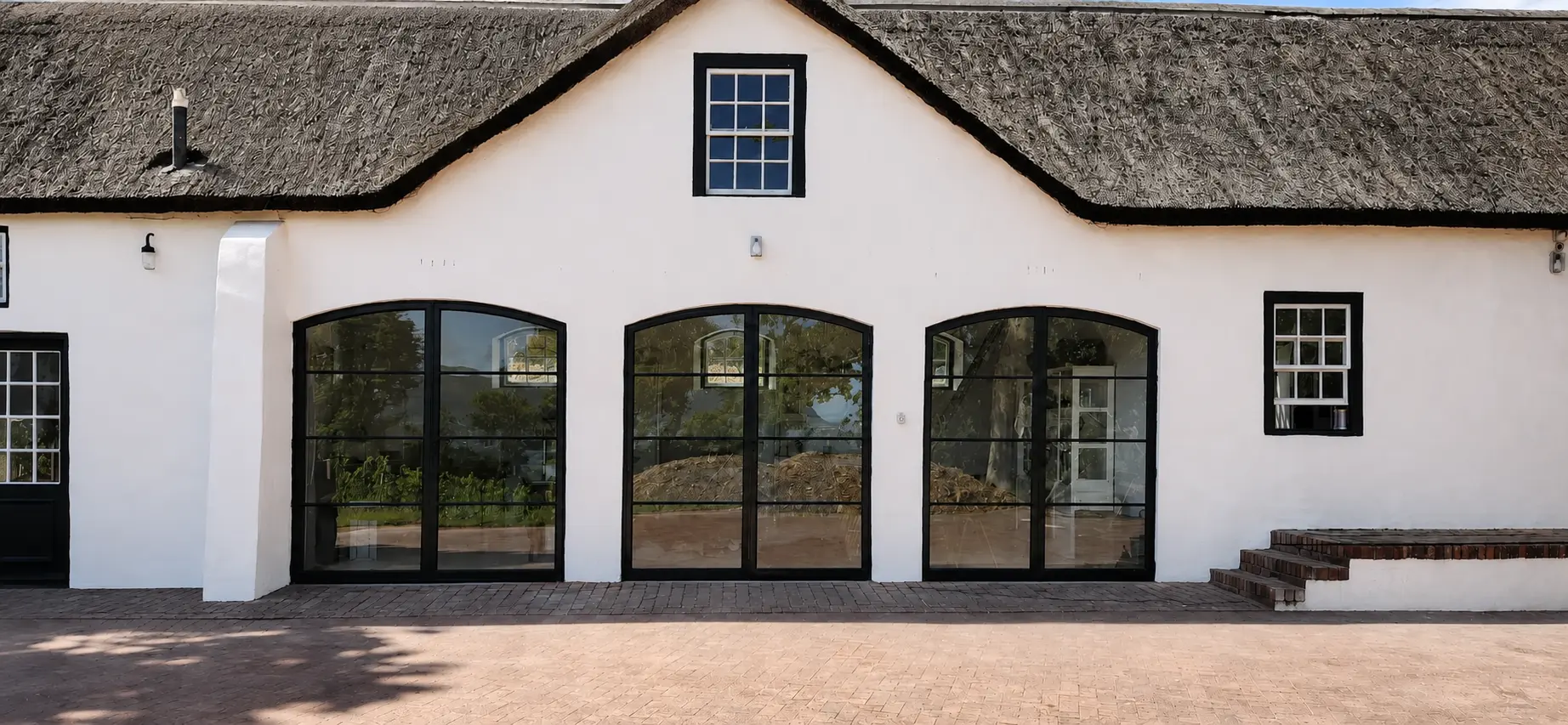
The Constantia project uses three arched double-door sets to create a highly individual residential elevation. At Loch Lynne Wine Estate, a former garage opening became a steel-and-glass façade. At Our Local in Cape Town, galvanised steel, stained glass and commercial panic hardware had to work together in an active restaurant shopfront.
These projects are far removed from mass-produced factory casements, yet they depend on the same essential advantage that shaped the history of the material: steel can carry glass with clarity, strength and comparatively fine proportions.
Steel windows endure because the frame can be structurally present without becoming visually heavy.
What the history teaches us
The history of steel windows is useful because it improves present-day decisions.
- Identify before altering. A historic frame may be significant, repairable or part of a coherent elevation.
- Judge the complete opening. Frame, glass, hardware, perimeter, drainage and surrounding building fabric work as one system.
- Design from proportion. The size and rhythm of each pane matters as much as the outer dimensions.
- Match protection to exposure. Coastal projects require disciplined preparation, coating and maintenance.
- Choose repair or replacement deliberately. The correct route depends on condition, heritage value, safety, performance and the architectural brief.
That final decision is explored in Article 04: Why Heritage Steel Windows Should Be Repaired Before They Are Replaced.
The D&G Fenestration Knowledge Series
This is Article 03 in our recurring series of practical, technically grounded guidance on glass, windows, doors, custom steel and aluminium systems, and heritage repair.
- Article 01: The History of Glass—How One Material Changed the Way We Build
- Article 02: Why Old Glass Looks Wavy—and Why It Matters
- Article 03: The History of Steel Windows—From Factory Floors to Modern Cape Town Design
- Article 04: Why Heritage Steel Windows Should Be Repaired Before They Are Replaced
- Read next: Article 05: How Modern Safety Glass Actually Works
Planning a steel opening of your own? Explore D&G’s custom steel work, then send photographs, approximate sizes and your project location for a practical assessment.
Request a project assessment from D&G Window Solutions.
Further reading and sources
- Science Museum: Sir Henry Bessemer and the bulk production of steel
- Crittall Windows: Company and steel-window history
- Historic England: Traditional Windows—Their Care, Repair and Upgrading
- Historic England: Historic Steel-Framed Windows
- US National Park Service: The Repair and Thermal Upgrading of Historic Steel Windows
- Victoria and Albert Museum: Modernist Architecture—the Bauhaus and Beyond
- Hot Dip Galvanizers Association Southern Africa: How Zinc Protects